
AI Powered Fitness Analytics App — Student Project Guide
Developed by SlideScope Institute
A Complete Full-Stack AI-Powered Fitness Application for Modern Developers
Project Overview
AI Fitness app is a comprehensive, full-stack web application developed by SlideScope Institute as a flagship student project that bridges the world of software development with the growing health-tech industry. This project is far more than just a coding exercise — it is a real-world, industry-relevant application that teaches students how to build production-grade software systems from the ground up. From user authentication and database design to AI-powered analysis and dynamic data visualization, AI Fitness app covers the complete spectrum of modern web development.
The application is designed to serve as a personal AI fitness coach, helping users track their physical progress, receive intelligent health insights, follow personalized workout plans, and maintain nutritional awareness. Behind this polished user experience lies a sophisticated technical architecture that students will learn to design, develop, test, and deploy.
What Students Will Learn
1. Full-Stack Web Development
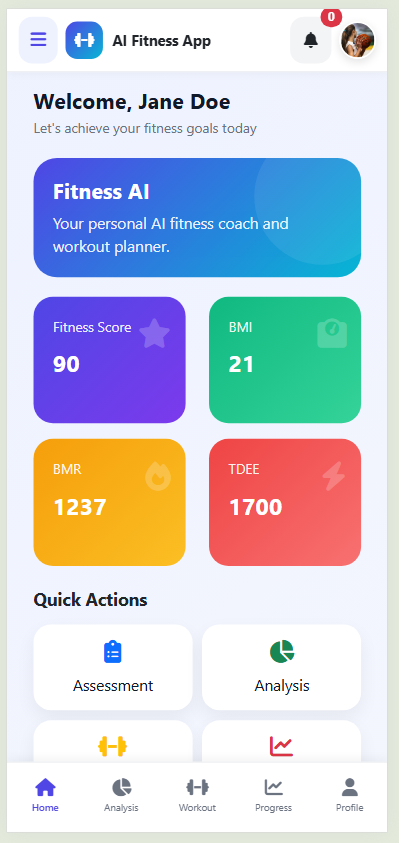
Students will gain hands-on experience in building both the front-end and back-end layers of a complete web application. On the front-end, learners will work with modern frameworks to build responsive, mobile-first user interfaces — exactly like the dashboard, progress charts, and quick-action panels visible in AI Fitness app. On the back-end, students will design RESTful APIs, manage server-side logic, and handle user sessions and data persistence securely.
2. Database Design and Management
One of the foundational skills in this project is relational database design. Students will learn how to model complex real-world data such as user profiles, fitness assessments, workout logs, and measurement histories. They will understand how to write efficient queries, manage relationships between tables (such as linking a user to multiple progress entries), and implement data validation at the database level. This knowledge is directly applicable to virtually every software role in the industry.
3. AI and Machine Learning Integration
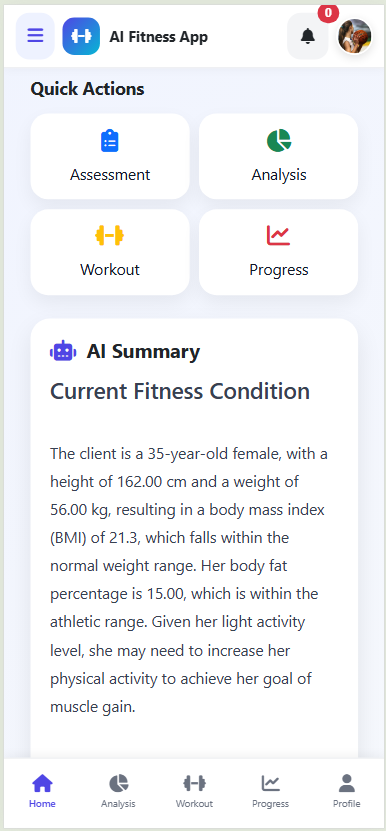
AI Fitness app introduces students to one of the most exciting areas of modern technology — artificial intelligence integration. Rather than building an AI model from scratch, students learn the equally valuable skill of consuming and integrating AI APIs into their applications. The AI Summary feature, which generates plain-language fitness condition reports based on user data, teaches students how to structure prompts, handle API responses, and present AI-generated content in a user-friendly way. This mirrors exactly how AI is being used in industry today — not as a replacement for developers, but as a powerful tool that developers learn to harness.
4. Data Visualization and Analytics
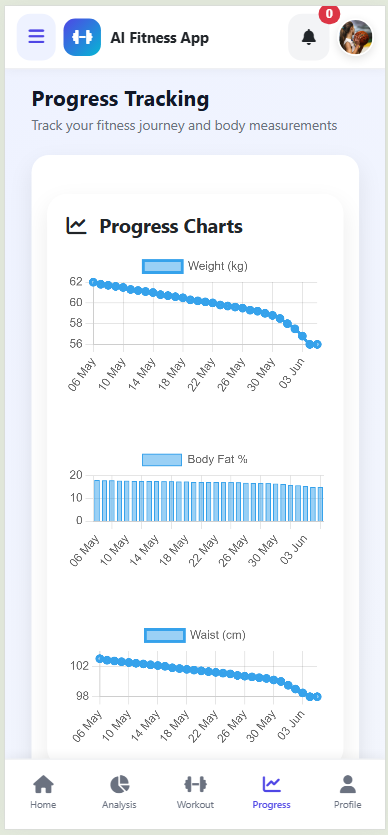
Progress Tracking is one of the most visually rich features of AI Fitness app. Students will learn how to collect time-series data such as weight, body fat percentage, and body measurements, and then render that data as interactive charts and graphs. They will work with data visualization libraries to build line charts, bar graphs, and trend indicators. Understanding how to transform raw numbers into meaningful visual stories is a highly sought-after skill in product development, business intelligence, and data analytics.
5. User Authentication and Security
Building secure applications is non-negotiable in the software industry. Through this project, students will implement industry-standard authentication flows including user registration, login, session management, and password security. They will learn how to protect sensitive health data, implement access controls so users can only view their own records, and apply best practices in web security such as input validation and secure API communication.
6. Form Design and User Input Handling
The fitness assessment module of AI Fitness app involves collecting a wide range of user inputs including age, height, weight, activity level, goals, and body measurements. Students will learn how to design multi-step forms, validate user inputs on both the client and server sides, handle edge cases gracefully, and provide meaningful feedback when users make errors. These form-handling skills transfer directly to e-commerce checkouts, onboarding flows, and any data-collection interface.
7. Business Logic and Calculations
AI Fitness app computes several health metrics in real time — including Body Mass Index (BMI), Basal Metabolic Rate (BMR), and Total Daily Energy Expenditure (TDEE). Students will learn how to implement domain-specific business logic, translate formulas into clean reusable code, and display the results dynamically. Learning to handle numeric computation, unit conversion, and edge cases builds the kind of analytical thinking that engineers use every single day.
8. Project Architecture and Code Organization
Beyond individual features, students will learn how to think about an entire application as a system. They will study how to organize their codebase into logical modules, separate concerns between different layers of the application, and write maintainable, scalable code. Understanding project architecture is what separates a junior developer from a mid-level one, and this project gives students a concrete, practical context in which to develop that architectural thinking.
Scope of the Project
The scope of AI Fitness app is deliberately broad, covering a wide range of features that give students exposure to many different technical domains within a single, coherent application.
Core Modules and Their Scope
User Management
The application includes complete user lifecycle management — from account creation and profile setup to profile editing and account settings. Students will build secure registration forms, implement login flows, and manage authenticated sessions. This module alone introduces concepts that appear in virtually every software product built today.
Fitness Assessment Engine
This module captures detailed information about the user’s physical condition, lifestyle, and fitness goals. The scope includes designing a multi-field assessment form, storing responses, and using that data as the foundation for all personalized features within the app. Students will learn how to design data models that capture complex, domain-specific information.
AI-Powered Analysis
The analysis module generates a personalized health and fitness report for each user. It uses the assessment data to identify the user’s strengths and weaknesses, highlight opportunities for improvement, and deliver actionable recommendations. The scope here includes integrating with external AI services, formatting AI responses for readability, and refreshing the analysis as user data changes over time.
Workout Planner
The workout planner generates customized weekly exercise routines based on the user’s goals, preferred workout days, experience level, and available equipment. Students will learn how to build rule-based or AI-assisted planning logic, present structured workout data in a readable format, and allow users to interact with their plans.
Nutrition Guidance
This module provides calorie and macronutrient targets based on the user’s TDEE and goals, whether that is weight loss, muscle gain, or maintenance. Students will learn how to implement nutritional formulas, display guidance in a structured format, and update recommendations as the user’s profile changes.
Progress Tracking and Visualization
Users can log body measurements over time, view historical entries, add backdated records, and track multiple metrics simultaneously through interactive charts. The scope of this module includes database design for time-series records, chart rendering with real data, and filtering or date-range selection for historical views.
How This Project Is Useful for Your Career
Building the AI Fitness app application will position students as competitive candidates in the technology job market. Here is how this project translates into real career advantages:
1. A Portfolio-Ready Project
One of the most common challenges for fresh graduates is having something meaningful to show potential employers. AI Fitness app is a polished, feature-rich application that demonstrates practical ability across multiple technical domains. When a student can open their laptop in an interview and walk through a live, working application with real data, real charts, and real AI features, it makes an impression that no academic grade can replicate.
2. Relevant to High-Growth Industries
Health technology is one of the fastest-growing sectors in the global economy. Fitness apps, wearable integrations, telemedicine platforms, and wellness tools are attracting significant investment and creating thousands of engineering roles. By building a fitness application, students demonstrate familiarity with this domain, which is directly relevant to companies building products in this space.
3. Demonstrates AI Literacy
Employers in 2025 and beyond are actively seeking developers who can work with AI tools and APIs. The ability to integrate AI into a product — not just talk about it theoretically — is a genuine differentiator. Students who have built AI Fitness app can speak confidently about prompt engineering, API integration, and how to present AI outputs in user-facing products.
4. Covers the Full Development Lifecycle
Many students learn individual skills in isolation. AI Fitness app gives students the experience of building something end-to-end — from initial requirements and database design, through feature development and testing, to a deployed, usable product. This full-lifecycle experience is exactly what employers mean when they say they want someone who can hit the ground running.
5. Transferable Technical Skills
Every technical skill learned in this project — REST API design, database management, authentication, data visualization, form handling, and AI integration — is transferable to virtually any software product. Whether a student goes on to build e-commerce platforms, SaaS tools, mobile apps, or enterprise software, they will draw on these same foundations repeatedly throughout their career.
6. Problem-Solving and Debugging Experience
Building a real application means encountering real problems. Students will debug broken API calls, fix data rendering issues, resolve authentication errors, and handle unexpected edge cases in user input. This hands-on problem-solving experience builds the kind of engineering intuition that cannot be taught in theory — it can only be earned by building.
7. Strong Foundation for Freelancing
For students interested in freelancing or independent consulting, AI Fitness app demonstrates the ability to deliver a complete, client-ready product. Health and wellness businesses, personal trainers, gym owners, and wellness coaches are an active market for custom app development. A student who has built Fitness AI has the credibility to pursue such projects with confidence.
A Message from SlideScope Institute
At SlideScope Institute, we believe that the best learning happens through building. AI Fitness app was designed not just as a course project, but as a genuine product that students can be proud of. Every feature in the application was chosen to maximize learning value while producing something that looks, feels, and functions like a professional-grade software product.
As you work through this project, remember that every challenge you encounter is an opportunity to grow as a developer. The skills, habits, and problem-solving mindset you develop here will follow you throughout your career — whether you go on to join a startup, contribute to an enterprise product, or build your own application from scratch.
Welcome to the AI Fitness app project. Build it well, and it will serve you well.
— SlideScope Institute
AI Fitness app App Features
AI Fitness app is a smart fitness tracking and workout planning application designed to help users achieve their health and fitness goals through personalized guidance and progress monitoring. The app begins with a detailed fitness assessment where users enter information such as age, gender, height, weight, activity level, fitness goals, workout preferences, and body measurements. Based on this information, the system generates an AI-powered fitness analysis that highlights strengths, weaknesses, opportunities for improvement, and recommendations.
One of the key features of the app is the personalized workout planner, which creates customized exercise routines according to the user’s goals, available workout days, experience level, and workout location. The app also provides nutrition guidance to support weight loss, muscle gain, or overall fitness improvement.
The Progress Tracking module allows users to record measurements such as weight, body fat percentage, waist, chest, arms, hips, and thighs. Users can even add historical entries for past dates if they forgot to log their progress earlier. Interactive charts visualize changes over time, helping users understand their fitness journey at a glance.
Additional features include secure user registration and login, profile management, dashboard summaries, historical progress records, and detailed analytics. By combining fitness assessments, AI insights, workout planning, nutrition advice, and progress monitoring, AI Fitness app serves as a complete digital fitness companion for students, professionals, and fitness enthusiasts seeking structured and measurable results.